
Leave The Leaves Campaign: From Campus To Your Backyard
By Jake Hartung, Horticulture Design Specialist
The National Wildlife Federation has designated October as Leave the Leaves Month! But, during the Fall and Winter there are important ways to leave the leaves on your property. Some trees won’t drop their leaves until the new spring growth emerges, and others follow the typical pattern of dropping in autumn. You could do something as simple as extending the size of the mulch ring under your shade trees, giving a “fall zone” for caterpillars to land somewhere safe. And, to make it even safer, consider planting shrubs and ground covers in the drip-zone of your trees instead of a lawn.
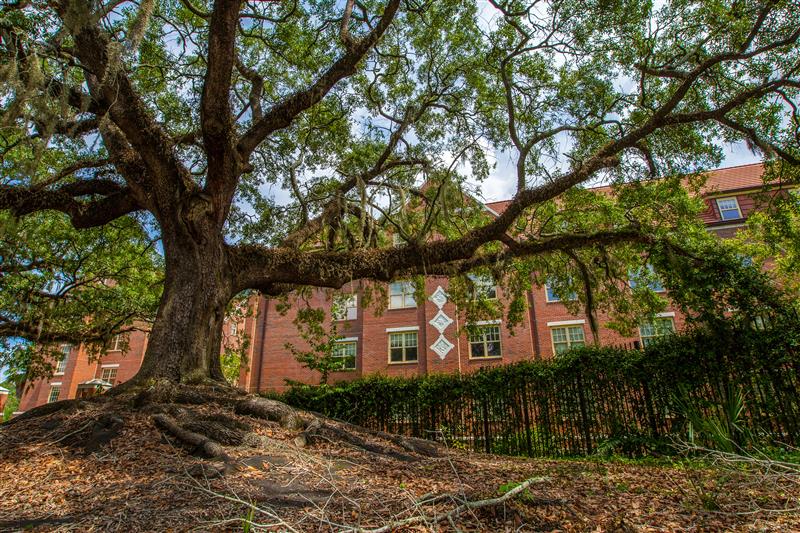
A fall zone of leaves underneath a Live Oak at DeGraff Hall.
As we head into autumn, many trees and shrubs shed their leaves or needles in preparation for their winter dormancy. The standard practice is to rake up or blow away all the leaves and bag them for the trash – but doing that causes pollution and further disconnects our cities, towns and neighborhoods from the local ecosystem. It also hurts wildlife. What do fallen leaves have to do with wildlife? Turns out the fallen leaf layer that forms each autumn as plants drop their foliage is incredibly important habitat for many kinds of wildlife.
Salamanders, birds, butterflies, moths, turtles, and pollinator bees are some of the examples of the beneficial wildlife that rely on leaf litter. How Much? – A leaf layer of 3-5 inches deep is usually a good amount for most garden beds. Don’t pile them on top of your plants but instead put them around the plants to cover any open soil, just like any other kind of mulch. They’ll suppress weeds, preserve soil moisture and naturally compost and return nutrients directly to the root zone of your plants as they break down.

Example of a leaf layer in the natural area outside of the Dirac Science Library.
Too Many Leaves? – If you have too many leaves, you can add them to your compost pile or simply make a big leaf pile in an out-of-the-way corner of your yard. They’ll break down and form a type of compost called leaf mold that can be added as natural fertilizer around your plants in the spring. A mulching mower will chop leaves on your lawn into tiny bits to enrich the soil. If your community has a leaf composting program, that’s a good option too. These methods eliminate much of the wildlife benefit from the leaves but it’s far better than throwing them away.
FSU Facilities Grounds & Landscaping has a large compost pile at our nursery where we haul organic debris from the campus daily. The larger limbs and tree trunks are then ground up into wood chips once a year, which we reuse as mulch on the campus as a sustainable practice.

Campus garden outside of the Student Services Building using composted mulch.